Broadband / DIA
Consumer-grade broadband and business-grade Dedicated Internet Access both ride the public internet, but they are priced, contended and supported very differently.
Overview
Broadband and DIA (Dedicated Internet Access) are both ways of getting a site onto the public internet, but they sit at opposite ends of what you get for the money.
The one-line version: Broadband buys inexpensive, usually shared internet capacity; DIA buys committed capacity and stronger operational guarantees. The access technology underneath (fiber, cable, copper, wireless) does not by itself determine which service you have.
Two different “DIA”s. On this page, DIA means Dedicated Internet Access: an internet access service with committed bandwidth and an SLA. In SD-WAN discussions, DIA can also mean Direct Internet Access: local internet breakout at a branch, sending traffic straight to the internet instead of backhauling it. These are unrelated concepts that happen to share an acronym, and mixing them up in a customer conversation is an easy, credibility-costing mistake.
Broadband is the general term for consumer and small-business internet access delivered over cable (DOCSIS), DSL, or fiber-to-the-premises sold as a residential or prosumer product. It is normally a shared, contended service: the bandwidth you are quoted is a ceiling, not a promise, and the provider is selling the same local infrastructure to many customers on the assumption that not everyone uses it at once. There is typically no SLA, or a very thin one, and support is built for a household, not a business with an outage clock running.
DIA is a different commercial product, built on the principle that the bandwidth in the contract is reserved for you and backed by contractual service commitments, not necessarily a physically exclusive circuit. The exact access architecture depends on the provider: sometimes a genuinely dedicated fiber run, sometimes a shared physical medium with committed bandwidth enforced further up the stack. DIA is normally symmetric (upload matches download) and comes with a real SLA: committed uptime, a repair-time commitment, and often latency and packet-loss commitments on the provider’s own network. You pay a premium for that certainty.
Both broadband and DIA connect you to the internet, not to each other. Neither is a private network the way MPLS or a P2P circuit is. Traffic on broadband or DIA crosses the public internet in the same way it would from a home connection: it is not isolated from other traffic, and it is not encrypted by the access type itself. If confidentiality or a private path between your own sites matters, that is a separate decision: a VPN, an SD-WAN encrypted overlay, or a different underlay entirely.
Dedicated ≠ private or secure. DIA’s “dedicated” means committed, guaranteed bandwidth, not a private, isolated network the way MPLS or a P2P circuit is, and not encryption. DIA still provides access to the public internet, so exposure and confidentiality have to be handled with firewalling, encryption and access control on top.
Where it fits
Broadband and DIA are both underlay access: the physical circuit that gets a site onto the internet. They provide reachability to the internet, to cloud on-ramps, and to SaaS. They do not provide connectivity between your own sites on their own: that is built on top, typically by an SD-WAN overlay establishing encrypted tunnels across one or more internet circuits, or by simpler site-to-site VPNs.
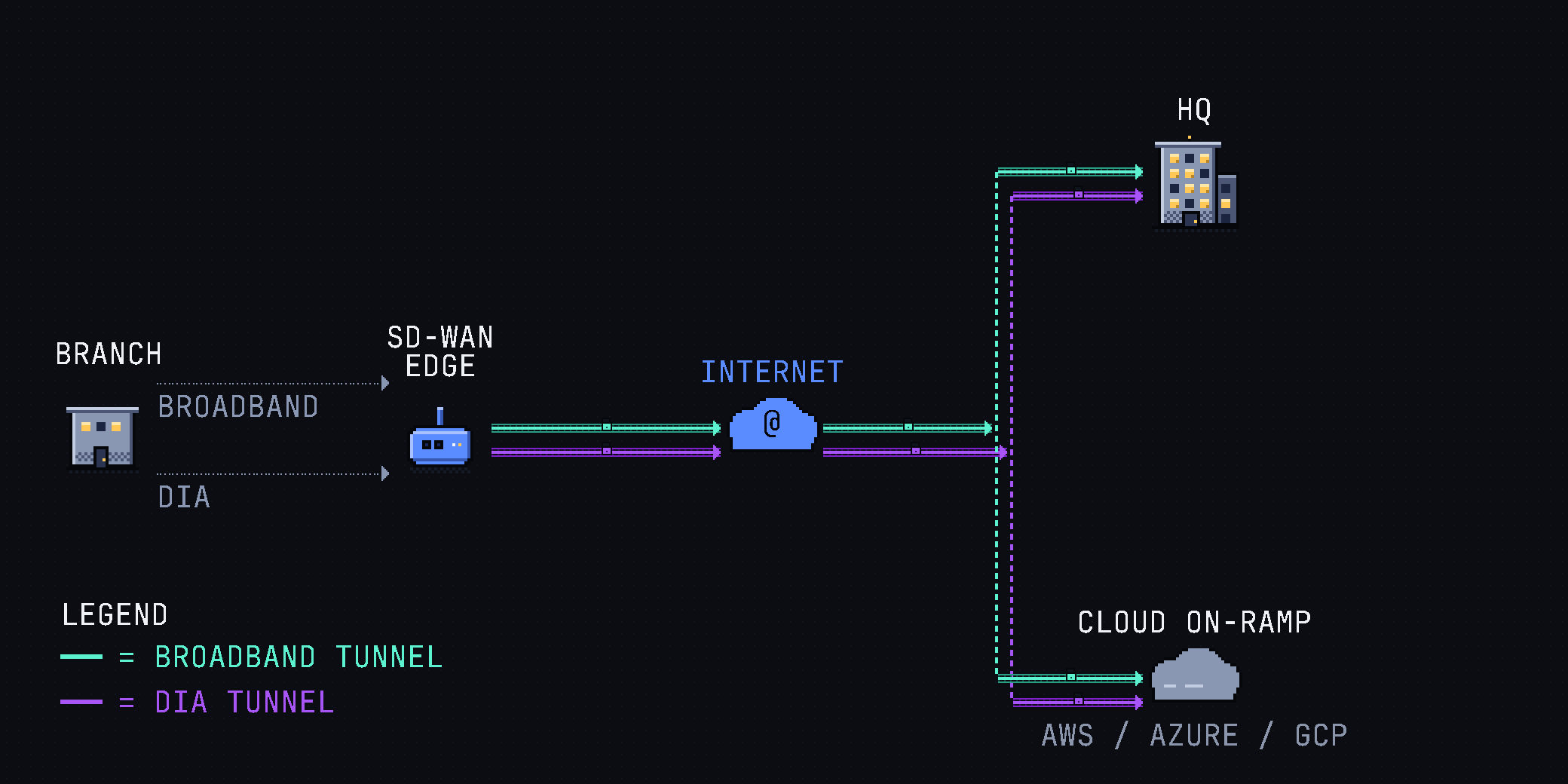
- What it provides: IP reachability to the internet, nothing more. Bandwidth, and, for DIA, a committed level of it.
- What it is not: a private network, an overlay, or a security control: those are separate decisions built on top.
- What runs over it: SD-WAN overlays run over broadband and DIA constantly, often pairing a cheap broadband circuit with a second broadband or DIA circuit at the same site for path diversity. VPNs, direct SaaS access, and cloud on-ramps such as a software-defined connection into a hyperscaler’s edge all use this same access.
How it works
The access technologies
Broadband and DIA both ultimately ride one of a small set of physical delivery methods:
| Technology | How it delivers the signal | Typical use |
|---|---|---|
| DOCSIS (cable) | Shared coaxial cable, contended with neighbors on the same segment | Consumer and small-business broadband |
| DSL | Copper phone line, distance-limited | Legacy broadband, declining where fiber is available |
| PON / fiber-to-the-premises (FTTP) | Shared fiber split across multiple premises at a local node | Consumer and increasingly business broadband |
| Dedicated fiber access | A fiber run not split or shared downstream of the provider’s handoff | The usual physical basis for DIA |
| Ethernet over copper / fiber | Carrier Ethernet handoff, can be dedicated or shared depending on the product | Business broadband and DIA, especially where fiber is not yet built |
| Fixed wireless access (FWA) | Licensed or unlicensed radio to a rooftop or premises antenna | Broadband where wired options are poor, or as a diverse backup path |
The technology underneath a broadband or DIA product does not by itself tell you whether it is contended. A PON fiber connection is commonly sold as consumer or small-business broadband, shared with other homes or units on the same split, while other provider architectures (a dedicated fiber pair, an Ethernet handoff, or committed bandwidth enforced further up the stack on the same shared medium) can deliver dedicated business services with committed bandwidth. Fiber does not automatically mean DIA, and DIA does not automatically mean a particular physical technology. The commercial product, not the cable type, is what determines whether you are sharing.
Contention and what “dedicated” actually means
Broadband’s economics depend on contention: the provider oversubscribes the shared infrastructure, betting that average usage stays well below the sum of every customer’s plan speed. This works, most of the time. But at peak hours, in dense apartment buildings, or on older cable plant, it shows up as throughput that quietly drops below what was advertised, without any fault being logged anywhere.
DIA removes that bet. “Dedicated” means the bandwidth in the contract is reserved for you and backed by contractual service commitments, not a shared pool you are hoping stays uncongested. That is the fundamental difference in bandwidth commitment. The other major part of the value proposition is the SLA and operational accountability that normally comes with it: repair commitments, performance targets, business support, and typically static routable addressing.
The SLA, and what it actually covers
A DIA SLA typically commits to:
- Uptime, expressed as a percentage with defined exclusions (maintenance windows, force majeure).
- Repair-time commitment, often expressed as a target or maximum time to restore service after a qualifying fault. The exact terminology varies by provider.
- Latency, jitter and packet loss, but normally only measured within the provider’s own network, not end-to-end to an arbitrary destination.
Broadband generally has none of this, or a best-effort statement with no financial credit attached. That difference in accountability, more than any technical distinction, is what companies are actually paying for when they buy DIA over broadband.
Symmetric vs asymmetric
Most residential broadband is asymmetric: download speed is marketed heavily, upload is a fraction of it, because the product was designed around consuming content, not sending it. DIA is normally symmetric. This matters more than it looks: cloud backup, large uploads, video conferencing at scale, VoIP trunking, and any other application generating significant upstream traffic all depend on upload bandwidth. A site sized only on its download number will be surprised when upload becomes the bottleneck.
Flavors & variants
| Variant | What it is | Typical fit |
|---|---|---|
| Residential-grade broadband | Consumer cable, DSL or fiber, sold to businesses because it is cheap and available | Small branches, backup circuits, low-criticality sites |
| Business broadband | Same access technology, marketed to businesses with slightly better support and sometimes a static IP | Mid-size branches where DIA is not justified |
| DIA over dedicated fiber | A circuit not shared downstream of the handoff, symmetric, with a full SLA | Data centers, HQ, any site where an outage is expensive |
| DIA over Ethernet access (EoC / EFM) | Business Ethernet handoff, dedicated bandwidth, sometimes over bonded copper pairs where fiber is not built | Sites where fiber is not yet available but a real SLA is still required |
| Burstable DIA | A committed baseline with the ability to burst above it, billed on usage above the commit | Sites with variable but predictable peaks |
| Fixed wireless access (FWA) | Radio-based, can be sold as either consumer broadband or a business product with an SLA | Rural or underserved areas, or as a physically diverse backup path |
| 4G / 5G (cellular) | Covered on its own page, mentioned here only as a common pairing for path diversity alongside wired broadband or DIA | Backup circuit, temporary sites, kiosks |
Pros & considerations
What it does well
- Cost per megabit. Broadband is typically the cheapest way to get meaningful bandwidth to a site, often by a large margin over MPLS or DIA for the same throughput.
- Availability and speed of provisioning. Broadband is usually installable in days to a few weeks where it already passes the building, far faster than a private circuit.
- Bandwidth headroom. Upgrading a broadband plan is often a phone call and a modem swap, not a carrier project.
- DIA’s accountability. A real SLA with credits gives you someone to call and a contractual reason for them to fix it quickly, without the price of a fully private network.
- Works well as an SD-WAN transport. Paired with an overlay, one or more broadband or DIA circuits can deliver performance that is good enough for most applications, at a fraction of the cost of MPLS.
Trade-offs
- Consumer broadband is best-effort; business broadband varies. Consumer broadband is generally best-effort. Business broadband may include support commitments or even an SLA, but these are typically less comprehensive than the commitments associated with DIA. Proving a pattern of poor performance to get a credit or an upgrade, where a commitment exists at all, is often more effort than it is worth.
- Contention is invisible until it isn’t. A circuit that tests fine at 10 a.m. can be markedly worse at 8 p.m. in a residential-heavy area, and nothing in a standard monitoring dashboard will explain why.
- DIA costs more, sometimes a lot more. The SLA and committed bandwidth are not free, and pricing per site can vary sharply depending on how close the nearest qualifying infrastructure is. The gap varies too much by location, provider and access technology to give a meaningful ratio. Get quotes for the specific sites in scope rather than relying on rules of thumb.
- Public internet exposure. Both provide connectivity to the public internet, but the customer’s WAN addressing can be public, private/NATed, or carrier-NATed depending on the service. There is no inherent isolation from other traffic, unlike a private carrier network.
- No encryption by default. Whatever confidentiality the site needs has to be added, typically via an SD-WAN overlay or VPN, and does not come from the access type itself.
- Availability is geography-dependent. Dedicated fiber DIA is not available everywhere, and in some areas the realistic choice is broadband or nothing, regardless of budget.
- Provider quality varies by region and even by street. A cable or DSL provider that performs well in one part of a city can be genuinely poor a few blocks over, depending on how the local plant was built and maintained.
Common pitfalls
Assuming broadband will behave like DIA once SD-WAN is added. SD-WAN can route around a bad path and mask a lot of internet variability, but it cannot invent bandwidth or fix a congested last mile. Sites where the traffic mix is genuinely latency-sensitive still need either DIA or enough broadband diversity to make up the difference.
Sizing on download speed alone. A site pushing backups, video, or SaaS uploads to the cloud needs the upload number, and on asymmetric broadband that number is often a fraction of what is advertised on the box.
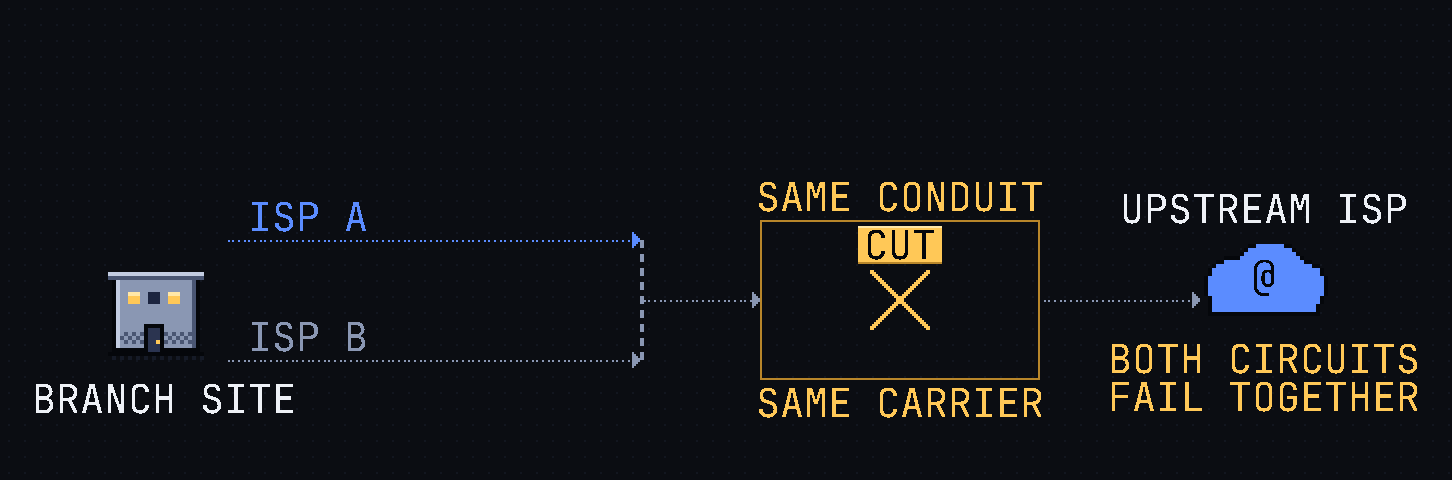
“Two ISPs” that are not actually diverse. Buying broadband from two different brands does not guarantee physical diversity. Both can ride the same cable plant, the same conduit, or even the same upstream provider under the hood, and a single backhoe or a single upstream outage takes both down together. Diversity has to be verified, not assumed from the provider’s name.
No visibility into the actual SLA scope. A DIA SLA usually covers the provider’s own network, not the whole path to a SaaS platform or the internet at large. A customer expecting the SLA to guarantee performance to Salesforce or Microsoft 365 will be disappointed the first time it is tested.
Dynamic IPs and NAT surprises on broadband. Consumer-grade broadband products often hand out a dynamic, sometimes carrier-NATed IP address, which breaks assumptions baked into VPN configurations, inbound firewall rules, or anything expecting a stable public address.
Treating “dedicated” as a security property. DIA is not shared bandwidth-wise, but it is still a connection to the open internet. It does not provide the isolation a private WAN service does, and teams sometimes carry that assumption over from the MPLS world by mistake.
What companies struggle with
- Justifying DIA cost at every site. DIA priced per site can add up fast, and the temptation is to either put it everywhere (expensive) or nowhere (risky at the sites that need it). The right answer is usually neither, and depends on what actually breaks if that site has a bad hour.
- Proving broadband performance before committing. Sales pitches promise good broadband-based SD-WAN performance; the only way to know if it is true for a specific site is a measured pilot on the actual circuits available there, not a coverage map.
- Managing many ISPs at scale. A retail or branch network can end up with dozens of different broadband providers, each with its own portal, support process, and billing cycle. Procurement and ongoing management of that sprawl is a real operational cost that rarely makes it into the initial business case.
- Local availability gaps. Not every site can get fiber DIA, and the fallback options (DSL, older cable plant, fixed wireless) vary enormously in quality by location, which makes a consistent global or national standard hard to hold to.
- Explaining why “the internet is the internet” is wrong. Non-technical stakeholders sometimes assume all internet connections are roughly interchangeable. The gap between a residential cable connection and a dedicated fiber circuit with an SLA is not obvious until something goes wrong.
- Backhaul habits left over from MPLS. Teams used to routing everything through a central firewall sometimes keep doing it even after moving to broadband and SD-WAN, missing the point of local internet breakout and adding latency for no reason.
Use cases & stories
Replacing MPLS with a tiered connectivity model
A manufacturer decided to move away from MPLS entirely across their whole network - not just at a handful of locations, but everywhere: manufacturing plants, offices, distribution centers and data centers. The challenge was that treating every site the same would either overspend on connectivity at locations that did not need it, or underserve the ones that did.
The approach started by classifying every location by criticality, and letting that classification drive the connectivity decision rather than applying a blanket replacement. The tiers ended up looking like this: the most critical locations received dual DIA circuits with 4G/5G as backup. Medium-criticality sites got one DIA circuit paired with broadband. Lower-criticality locations ran on dual broadband. The least critical sites had a single broadband connection with cellular as a fallback.
The lesson: moving off MPLS is not a decision about which one technology replaces it. It is a decision about what each site actually needs, and a tiered model that matches connectivity to criticality is both more cost-effective and more defensible than a uniform standard applied everywhere.
Escaping hub-and-spoke with local internet breakout
A logistics company had built their network around a classic hub-and-spoke MPLS architecture, with a single central location providing internet access for every other site. It worked until the volume of SaaS and cloud traffic made the detour through the hub impossible to ignore. Users at branch locations were hitting Microsoft 365 and other cloud applications through a path that added latency for no good reason, and the central internet breakout was becoming a bottleneck.
Moving to broadband and DIA at each location let them break out internet traffic locally instead, cutting out the round trip to the hub and making a noticeable difference for users on site. The piece that made it practical was centrally managed SD-WAN: local breakout without central control creates a policy and visibility problem, and SD-WAN solved that by letting the team manage all the local breakout policies from one place rather than configuring each site independently.
The lesson: local internet breakout is the right answer for most SaaS and cloud traffic, but it only works operationally when you have a centralized way to manage the policies that go with it.
Proving broadband before committing
A pharmaceutical manufacturer had MPLS running reliably across their sites and knew they probably wanted to move away from it eventually. The cost and inflexibility were hard to justify as more traffic moved to cloud and SaaS. But they were not willing to make the move on faith. Their concern was simple: they did not know whether broadband could actually match the reliability and consistency they were used to, and in a regulated manufacturing environment, finding out the hard way was not an option.
The approach was to introduce broadband in parallel with the existing MPLS setup - not as a live replacement, but as a way to observe real performance on their actual sites over time. The broadband circuits served as backup at first, but the more important function was generating real data about how they performed under realistic conditions, before any decision was made to migrate.
The lesson: when reliability trust is the real blocker to moving off MPLS, a parallel pilot that runs the alternative alongside the incumbent is often more valuable than any benchmark or vendor promise. It turns a leap of faith into an evidence-based decision, and in a regulated environment, that evidence matters.
Security & compliance considerations
What a specific framework or regulation requires of a broadband or DIA circuit depends on its scope, version and assessor, and is a question for the Compliance layer rather than something this page can answer definitively. What follows is about what broadband and DIA provide and do not provide as connectivity types.
- What they provide. IP reachability to the internet, and for DIA, a committed level of bandwidth and an SLA covering the provider’s own network. Nothing about either implies isolation from other internet traffic.
- What they do not provide. The access service itself provides no inherent confidentiality or integrity protection, and no access control between sites. “Dedicated” in DIA describes the bandwidth commitment, not a private or isolated path: the service provides access to the public internet rather than an isolated private WAN, so exposure has to be controlled by the customer, not assumed away.
- Encryption status. Neither broadband nor DIA encrypts traffic. Anything sensitive needs encryption added on top, typically through an SD-WAN overlay, a site-to-site VPN, or application-layer TLS. Treat both as public internet transport for planning purposes.
- Segmentation. There is none inherent to the access circuit itself. Segmentation between sites, between traffic classes, or between users has to be built at the overlay or firewall layer, not assumed from the access type.
- Provider and carrier risk. ISPs vary in how they handle route hijacking protection, DDoS mitigation on the access circuit, and incident notification. For DIA in particular, ask what the provider actually does if the circuit is targeted, since a dedicated circuit can still be a dedicated target.
- Data location. Once traffic leaves the customer’s access network, its path across the provider’s network, peering partners and transit networks is generally outside the customer’s direct control. For sovereignty or residency requirements, understand where traffic may be routed and what the provider actually commits to.
- Direct exposure. The access service provides connectivity to the public internet, so internet-facing exposure has to be controlled by the customer’s firewall and security architecture. Addressing can be a routable public IP, private/NATed, or carrier-NATed depending on the service, but none of those variants provide the isolation a private network’s own separation would. A misconfigured firewall on broadband or DIA is directly internet-facing in a way an MPLS handoff typically is not.
Related topics
- Underlay Design: start here before choosing between broadband, DIA, MPLS and other access types: design drivers and the comparison table this page feeds into.
- MPLS: the private-network alternative broadband and DIA are most often compared against, and increasingly paired with in hybrid designs.
- SD-WAN concepts: the overlay that typically sits on top of broadband and DIA to build usable site-to-site connectivity (coming soon)
- 4G / 5G (cellular): the usual pairing partner for broadband or DIA as a physically diverse backup path.