4G / 5G (cellular)
Cellular WAN access, useful as a primary circuit in specific cases, as a common backup path behind broadband, DIA or MPLS, and for getting a site online much faster than a wired circuit allows.
Overview
4G/5G (cellular) is WAN access delivered over the mobile carrier network instead of a fixed line. A router with a SIM and a cellular modem, or a dedicated cellular gateway, reaches the internet through the same radio network a phone does, using licensed spectrum the carrier operates.
As with broadband and DIA, there is a technology and there is the service enterprises actually buy. The technology is the radio access network itself, 4G LTE or 5G, and the generation in use at a given site depends on carrier rollout and device support, not on what you order. What enterprises buy is a cellular data plan: a SIM with a data allowance and, at the business end of the market, a static IP and sometimes an SLA. A private APN (Access Point Name) and Fixed Wireless Access (FWA) are two further, separate products built on that same radio network, each covered in detail below. A consumer SIM in a router and a carrier-managed cellular WAN product can use the identical radio underneath while being completely different commercial arrangements.
Private APN and Fixed Wireless Access are not the same product. A private APN is typically a distinct enterprise product or add-on a business negotiates with the carrier, not a feature you flip on for any standard SIM plan: the SIM’s traffic goes through a private carrier gateway, keeping part of the path off the public internet, but the connection itself still looks like any other cellular WAN link. Fixed Wireless Access (FWA) is a different product category entirely, a cellular-based broadband replacement marketed and provisioned like a home or small-business internet service. The two are easy to bundle together in conversation because both ride the same radio network, but an FWA plan does not include private-APN routing by default, and assuming otherwise is a real design mistake, not just loose terminology.
Cellular’s defining property is that it needs no wired circuit to the site. Fiber, cable and Ethernet access all depend on a wire reaching the building. Cellular depends on radio coverage that, in most developed markets, already exists. Cellular sits on this layer for the same reason broadband, DIA and MPLS do: it is physical access to the network, in cellular’s case delivered over radio instead of a wire. The lack of a wired last-mile build is cellular’s main practical advantage within this layer: it trades some performance and cost predictability for the ability to get a site connected without waiting on a wired install. Mobility for moving assets is a separate, independent advantage, covered later.
Cellular rides the public internet in the same sense broadband and DIA do. Traffic is not private or isolated from other carrier traffic by default, and it is not encrypted by the access type itself. A private APN can keep traffic off the public internet for part of the path within the carrier’s own network, but that is a specific product feature to ask for, not a property of cellular access in general. That trade, no wired last-mile build required in exchange for a public, unencrypted-by-default path, is the deal cellular offers at this layer.
Where it fits
Cellular is underlay access, the same layer as broadband, DIA and MPLS. It gets a site or a device onto the internet, or, with a private APN, onto a carrier-provided private path. It does not provide site-to-site connectivity on its own; that is built on top, typically by the same SD-WAN overlay or VPN used over any other transport.
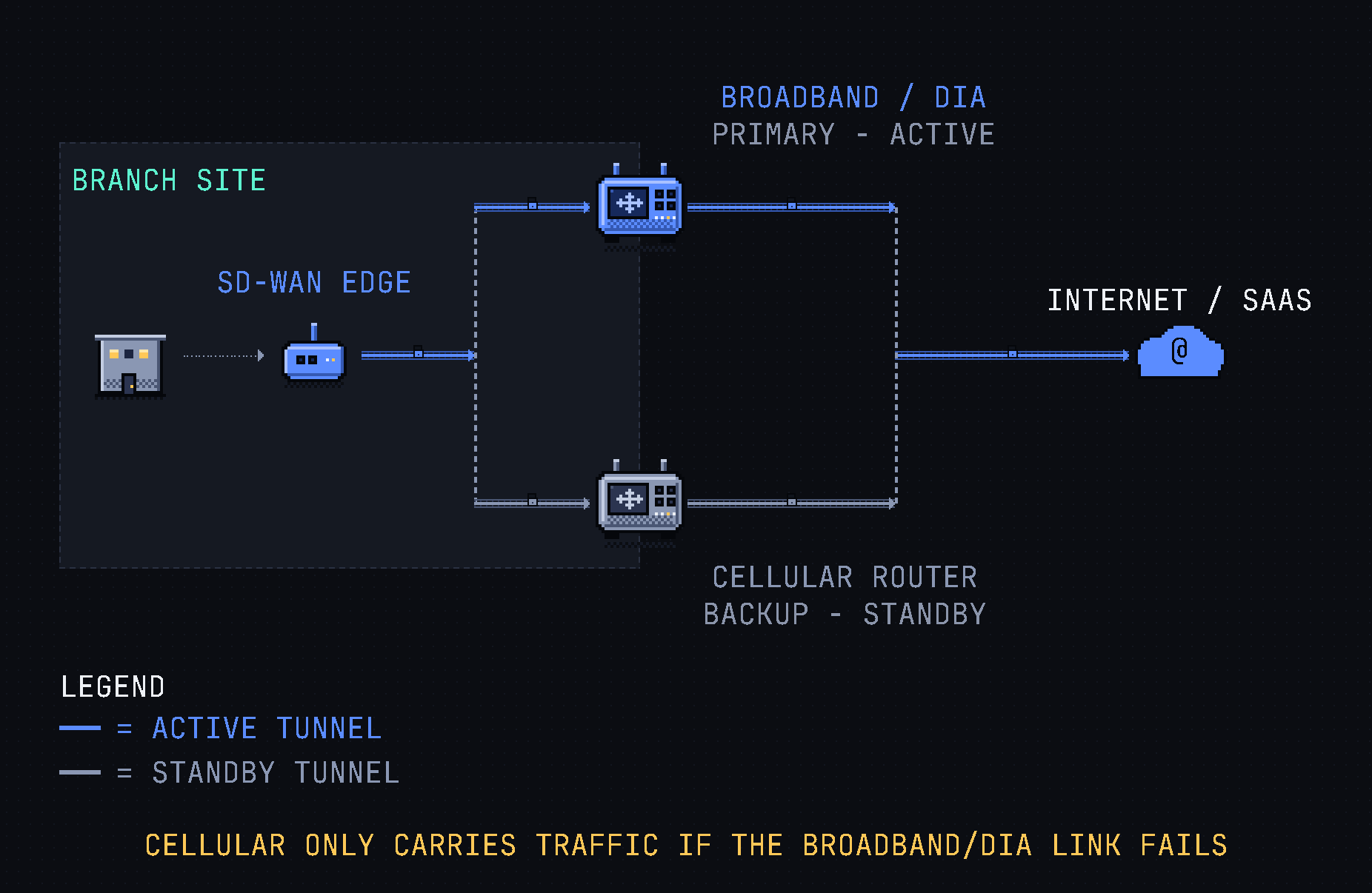
- What it provides: IP reachability over the carrier’s radio network, with a data allowance and, depending on the product, defined service or performance commitments.
- What it is not: a private network by default, a guaranteed replacement for a wired circuit at high-bandwidth or latency-sensitive sites, or a security control.
- What runs over it: SD-WAN overlays and VPNs run over cellular the same way they do over any other transport; how a specific path gets prioritized or steered between transports is a question for the SD-WAN layer.
How it works
Primary, backup and rapid deployment: three different jobs
Cellular shows up in enterprise WAN design in three distinct roles, and conflating them is where most confusion starts.
As primary access, cellular is the only circuit at a site, carrying all its traffic full-time. This fits a narrow set of conditions: small or low-bandwidth locations, kiosks, vending and digital-signage endpoints, vehicles, or sites where no wired option is available at a cost or lead time the business will accept. It is a real, sometimes correct choice for those cases, not a fallback used because nothing better exists.
As backup, cellular sits behind a wired primary circuit, MPLS, DIA or broadband, and only carries traffic when the primary path fails or degrades. In enterprise networks, backup is one of the most common roles for cellular. It does not need to match the primary circuit’s bandwidth; it needs to keep the site’s essential applications working until the primary path is restored.
For rapid deployment, cellular solves a timing problem rather than a performance or cost problem. A pop-up retail location, an event, a disaster-recovery site, or a new location that needs to be live before a wired circuit can be provisioned all have the same requirement: connectivity today, not connectivity in the number of weeks a fiber or Ethernet build normally takes. Cellular hardware can often be shipped, activated and generating traffic much faster than a new wired circuit can be provisioned.
Coverage, signal and what actually limits throughput
Cellular performance depends on factors a wired circuit does not have to deal with: distance to the nearest tower, the number of other devices sharing that tower’s capacity at a given moment, physical obstructions such as building materials or terrain, and which generation of radio technology the tower supports in that location. Two sites a few miles apart can see meaningfully different cellular performance for reasons that have nothing to do with the plan purchased.
5G, where available, generally offers higher throughput and lower latency than 4G LTE, but coverage and performance vary significantly by carrier and location. Coverage is often less mature outside dense urban areas, so rural and industrial sites should be checked individually. A site’s actual generation of service is a coverage and deployment question, not something guaranteed by ordering 5G.
Data plans and throttling
Cellular data plans are commonly metered or subject to usage policies in a way wired broadband and DIA typically are not. A plan has a data allowance, and behavior once that allowance is used varies by carrier and product: some plans throttle speed, some charge overage, some simply stop. Business-grade cellular WAN products can offer higher or unlimited allowances at a correspondingly higher price, along with static IP addressing and better support commitments than a consumer SIM. Metering, not the radio technology itself, is what makes cellular behave differently from a wired circuit once real volume moves across it.
The private APN option
A private APN (Access Point Name) is an enterprise service that directs a SIM’s traffic through a private gateway rather than the carrier’s normal public-internet gateway. That gateway can connect into the customer’s network or data center, keeping that segment of the path off the public internet within the carrier’s network. Internet-bound traffic and the connection from the carrier into the customer’s environment can still follow different paths depending on how the service is designed.
A private APN is therefore closer in spirit to a private WAN service than to consumer cellular data, but it remains a carrier-dependent service and should not be assumed to be available or priced the same everywhere. It is also separate from the data plan’s allowance and throttling policies.
Dual-SIM and multi-carrier designs
Because cellular performance depends heavily on which carrier has the best coverage at a specific site, dual-SIM routers running two different carriers are common in serious cellular deployments, whether cellular is primary or backup. This protects against a single carrier’s local outage or poor coverage, in the same way multi-ISP broadband designs protect against a single provider’s problem, and it is worth verifying the same way: two SIMs from two carrier brands does not guarantee two genuinely independent radio paths if both ultimately share backhaul infrastructure in that area.
Flavors & variants
| Variant | What it is | Typical fit |
|---|---|---|
| Consumer SIM in a router | Standard mobile data plan, no SLA, best-effort support | Small sites, quick backup on a budget |
| Business/enterprise cellular WAN | Carrier product built for fixed-site use, often with static IP and better support | Primary or backup access where some accountability is wanted |
| Private APN | Traffic routed through a private carrier gateway, keeping that segment off the public internet path; the route back to the customer network and internet-bound traffic can still cross the public internet depending on termination | Sites needing a more controlled path back to the corporate network over cellular |
| Fixed Wireless Access (FWA) | Cellular-based broadband replacement, marketed as a home or small-business internet product | Areas with poor wired options, sometimes used as a primary WAN circuit |
| Cellular gateway / failover router | Purpose-built hardware pairing a wired WAN port with a cellular modem for automatic failover | A common backup deployment pattern |
| Mobile / vehicle cellular | Cellular as the primary access for a moving terrestrial or vehicle-based asset; SATCOM plays the equivalent role for maritime and remote assets outside cellular coverage | Fleet, transportation, field operations |
Pros & considerations
What it does well
- No wired last-mile build required. Cellular can connect a site using existing tower infrastructure, without waiting on a wired install. This is a significant advantage over wired access types on this layer (MPLS, broadband, DIA, colocation, cloud on-ramps); SATCOM also avoids a wired last-mile build.
- Fast to deploy. Hardware can be shipped and activated in a short time, useful for temporary sites, disaster recovery and new locations under time pressure.
- Often an independent backup path. A cellular circuit typically does not share the same physical infrastructure (poles, conduit, local exchange) as a site’s wired circuit, so it tends to fail independently of it, which is exactly what a backup path needs to do.
- Mobile by nature. Cellular is well suited to moving terrestrial and vehicle-based assets.
- Improving performance. In areas with good 5G coverage, cellular can now provide throughput and latency that make it viable as a primary connection for more use cases than in the past.
Trade-offs
- Bandwidth and latency are generally worse than wired options. Even good cellular service is typically more variable in latency and lower in sustained throughput than a comparable wired circuit, and this varies significantly by location and time of day.
- Cost per gigabyte can be high for sustained traffic. Metered data plans can make cellular expensive for sustained production traffic compared with broadband or DIA, although the difference varies significantly by carrier, region and plan type.
- Coverage and generation are outside your control. A site’s actual cellular performance is set by tower placement and carrier rollout decisions; customer-side equipment (antenna choice, placement, modem quality) can affect the signal quality actually achieved, but it can’t change the underlying coverage or generation available at a site.
- Data caps create real operational risk as a primary circuit. A site relying on cellular as its only access can hit a plan’s allowance and get throttled or cut off during a busy period, which is a very different failure mode from a wired circuit simply being slow.
- No inherent privacy or encryption, the same as broadband and DIA. A private APN narrows this for part of the path but is a specific product to buy, not a default property of cellular service.
- Carrier and spectrum dependency. Spectrum licensing and infrastructure investment decisions rest with the mobile carrier, not the customer. Multi-carrier or dual-SIM designs (see above) can partially mitigate the resulting risk, but they don’t change the underlying dependency on a single carrier’s coverage and rollout decisions in a given area.
Common pitfalls
Sizing a cellular backup link for full production load. A backup circuit does not need to replicate the primary circuit’s bandwidth, it needs to keep the site’s essential applications running. Provisioning cellular as if it will silently absorb full traffic during an outage leads to a slow, capped, expensive surprise exactly when the business is already dealing with a primary circuit failure.
Assuming dual-SIM means dual independence. Two SIMs from two carriers is a good practice, but it is not automatically true diversity if both carriers share backhaul or tower infrastructure in that specific area. The same verification discipline that applies to “two ISPs” on the broadband/DIA page applies here.
Not testing failover, only installing it. A cellular backup circuit that has never actually carried traffic is a common source of “it should have worked” outages. Failover needs to be tested periodically, not assumed to work because it was configured once.
Treating a consumer SIM like a managed service. A cheap consumer data plan in a router has no SLA and often no dedicated business support line. Escalating a problem on it can be slower and less structured than escalating a problem on a wired circuit with an actual service contract behind it, which matters more than expected the first time a backup path is actually needed.
Missing the data cap until the bill or the throttling arrives. Cellular’s metered nature is easy to overlook when it is deployed as backup and rarely used, until an extended primary-circuit outage pushes usage past the plan’s allowance and the backup circuit itself starts failing.
What companies struggle with
- Justifying cellular as more than an afterthought. Cellular backup is often added late in a design, as a checkbox, without real thought given to what traffic it needs to carry or for how long, and without a tested failover process behind it.
- Budgeting for data usage that is hard to predict. Unlike a fixed monthly circuit cost, cellular spend can spike unpredictably if a primary circuit has an extended outage and cellular ends up carrying real production load for days.
- Comparing carriers without real site-level data. Coverage maps are typically based on modeled predictions rather than measured performance at a specific site. Verify with an on-site survey or a test device before committing.
- Explaining why “it has signal” doesn’t mean “it will perform.” Non-technical stakeholders sometimes assume a site with cellular phone coverage will automatically get good cellular WAN performance, missing that voice coverage and the throughput needed for business applications are different things.
- Rapid deployment timelines colliding with procurement processes. The whole value of cellular for a pop-up or disaster-recovery site is speed, but a slow internal hardware and carrier procurement process can quietly erase that advantage if it is not planned for in advance.
Use cases & stories
Two typical scenarios where cellular is the deciding factor:
A retail chain needed a new store online for a launch date that was fixed well before the wired ISP could commit to a circuit installation. Cellular routers were shipped to the site and activated as the sole connectivity for the first several weeks of operation, carrying point-of-sale, guest Wi-Fi and back-office traffic while the wired DIA circuit worked through the carrier’s normal provisioning process. Once the wired circuit went live, the cellular router was repurposed as the site’s backup path rather than removed. The lesson: cellular takes the wired lead time off the critical path. Planned as a bridge from day one, it let the store open on schedule, and the hardware kept its value once the wired circuit arrived.
A manufacturer with dozens of branch locations on MPLS wanted a backup path that did not depend on the same last-mile infrastructure as the primary circuit, after a regional outage had taken down MPLS and a secondary broadband circuit at the same time because both happened to run through the same local exchange. Dual-SIM cellular gateways, one SIM per carrier, were rolled out as the new backup standard, specifically chosen because a cellular tower failure and a wireline exchange failure are unrelated events. The lesson: real path diversity means checking what infrastructure a backup circuit actually depends on, not just buying from a different-sounding provider.
Security & compliance considerations
What a specific framework or regulation requires of a cellular WAN connection depends on its scope, version and assessor, and is a question for the Compliance layer rather than something this page can answer definitively. What follows is about what cellular access provides and does not provide as a connectivity type.
- What it provides: IP reachability over the carrier’s mobile network, and with a private APN, a path that can avoid the public internet for part of its route within the carrier’s own infrastructure.
- What it does not provide: confidentiality, integrity protection or access control by default. A consumer or standard business cellular connection provides public-internet access in much the same way broadband does.
- Encryption status. Cellular does not encrypt customer traffic by itself. The radio link between device and tower uses carrier-level protections, but that is not the same as end-to-end confidentiality for the customer’s traffic, which still needs to be added, typically via SD-WAN overlay encryption or VPN.
- Segmentation. None inherent to the access type. A private APN can provide some separation from general internet traffic within the carrier’s network, but segmentation between the customer’s own traffic classes still has to be built at the overlay or firewall layer.
- Provider and carrier risk. Cellular routers and SIM-based devices can be a target in their own right, and management access to cellular gateways deserves the same scrutiny as any other internet-facing device. Ask how the carrier handles SIM authentication, SIM replacement or theft, device authentication, account access and abuse detection.
- Data location. As with broadband and DIA, traffic’s path across the carrier’s network and any transit or peering it crosses is generally outside the customer’s direct control once it leaves the device. For sovereignty or residency requirements, this is a question worth raising with the carrier directly rather than assuming.
- Device management. Cellular gateways deployed at scale, especially unattended ones at remote or temporary sites, need the same remote-management, patching and physical-security discipline as any other network edge device, arguably more, since they are often the least frequently visited piece of hardware on the network.
Related topics
- Underlay Design: start here before choosing between cellular, broadband, DIA and other access types, design drivers and the comparison table this page feeds into.
- Broadband / DIA: the usual primary circuit cellular backs up, and the closest comparison for internet-routed access.
- SD-WAN concepts: the overlay that decides when to steer traffic onto a cellular backup path (coming soon)
- SATCOM / Satellite: the other access type that avoids a wired last-mile build on this layer, covering remote, maritime and mobile locations cellular coverage doesn’t reach (coming soon)